The top places to visit in Delhi are India Gate, Humayun’s Tomb, Qutub Minar, Lotus Temple, Red Fort, Jama Masjid, Akshardham, Rajpath & Rashtrapati Bhavan, and Connaught Place. Delhi has 3 UNESCO World Heritage Sites: Humayun’s Tomb, Qutub Minar, and Red Fort. Winter (October to March) is the best time to visit, and 3-4 days are enough to cover the main attractions.
Delhi is one of the busiest cities in India, packed with historical monuments. Whether you arrive with a plan or not, you will quickly find plenty of reasons to stay. It is one of India’s biggest tourist destinations, holding real historical weight, including 3 UNESCO World Heritage Sites within the city itself.
The mix of culture, history, cuisine, commerce and street life keeps visitors engaged throughout. First-time visitors are often overwhelmed by the chaos, but the city’s extraordinary monuments gradually pull you in. This guide covers the top 15 places to visit in Delhi, with timings, entry fees and nearest metro stations.
Key Highlights: Delhi at a Glance
Which Delhi Attractions Are Free, and What Do the Others Cost?
Nine of the 15 places are free to enter, although some charge extra for exhibitions or cameras. The table compares all of them, with fees shown as Indian / foreign nationals. Tap a name to jump to its section.
| Place | Entry fee | Timings | Nearest metro |
|---|---|---|---|
| India Gate | Free | 24 hours | Central Secretariat |
| Humayun’s Tomb | ₹35 / ₹600 | 6:00 am to 6:00 pm | Jor Bagh |
| Hauz Khas | Free | Restaurants open till midnight | Hauz Khas |
| Qutub Minar | ₹35 / ₹600 | 7:00 am to 5:00 pm | Qutub Minar |
| Lotus Temple | Free | 9:00 am to 5:00 pm | Kalkaji Mandir |
| Red Fort | ₹35 / ₹600 | 9:30 am to 4:30 pm, closed Mondays | Chandni Chowk |
| Lodi Gardens | Free | 6:00 am to 8:00 pm (approx.) | Jor Bagh |
| Jama Masjid | Free (camera fee may apply) | 7:00 am to 12:00 pm, 1:30 pm to 6:30 pm | Jama Masjid |
| Akshardham | Free (exhibitions extra) | 10:00 am to 6:30 pm, closed Mondays | Akshardham |
| Purana Qila | ₹35 / ₹600 | 7:00 am to 5:00 pm | Indraprastha |
| Rajpath & Rashtrapati Bhavan | About ₹50, booking required | 9:30 am to 5:30 pm | Central Secretariat |
| Jantar Mantar | About ₹5 / ₹100 | 9:00 am to 7:00 pm | Rajiv Chowk |
| Laxminarayan Temple | Free | 4:30 am to 1:00 pm, 2:30 pm to 9:00 pm | RK Ashram Marg |
| Indira Gandhi Memorial | Free | 9:30 am to 4:45 pm, closed Mondays | INA |
| Connaught Place | Free | Open all day (shops vary) | Rajiv Chowk |
1. India Gate

You cannot miss India Gate when you visit Delhi. Originally called the All India War Memorial, it commemorates the 82,000 soldiers who died during the First World War, between 1914 and 1921.
Located on the eastern side of Delhi, formerly known as Kingsway, its design by Sir Edwin Lutyens draws comparisons to the Arch of Constantine and Mumbai’s Gateway of India. Construction began in 1921 and finished in 1931. Every 26 January, the Republic Day parade passes through India Gate, one of the most prestigious events in India.
| Timings | 24 hours a day, seven days a week |
| Entry Fee | Free |
| Nearest Metro Station | Central Secretariat, New Delhi |
2. Humayun’s Tomb

Humayun’s Tomb is the resting place of the Mughal emperor Humayun, commissioned by his widow, Bega Begum. Located in Nizamuddin East, it is recognised as the first garden tomb on the Indian subcontinent and was declared a UNESCO World Heritage Site in 1993.
The complex also holds the graves of Dara Shikoh, Hamida Begum and other Mughal family members. Built of red sandstone with white marble accents, it stands as a lasting symbol of Bega Begum’s grief and devotion after her husband’s death.
| Timings | 6:00 am to 6:00 pm |
| Entry Fee | ₹35 (Indians); ₹600 (foreign nationals), 2026 ASI rates |
| Nearest Metro Station | Jor Bagh, New Delhi |
3. Hauz Khas

Hauz Khas, in South Delhi, blends historical weight with a lively urban scene. In Urdu, “hauz” means water and “khas” means royal, so Hauz Khas translates to “royal tank,” referring to the ancient water reservoir Alauddin Khilji built to supply the Siri Fort inhabitants.
The area was redeveloped from the 1960s onward and today holds village cafes, pubs, restaurants and boutiques, bordered by a green park to the west and Gulmohar Park to the north. It’s easy to reach from any part of Delhi, making it a solid addition to your itinerary.
| Timings | Most restaurants and pubs stay open till midnight |
| Entry Fee | Free (the deer park and monument complex) |
| Nearest Metro Station | Hauz Khas, New Delhi |
4. Qutub Minar

Qutub Minar is one of Delhi’s most important historical structures and a UNESCO World Heritage Site, located in the Mehrauli area. Built of red sandstone and marble, it stands 73 metres tall across five storeys, tapering from a 14.3-metre base to 2.7 metres at the top.
A spiral staircase of 379 steps runs through the tower. Historians believe its design drew inspiration from the Minaret of Jam in western Afghanistan, and its artistic details, including looped bells and lotus motifs, echo Iranian architectural style. It’s open daily between sunrise and sunset.
| Timings | 7:00 am to 5:00 pm |
| Entry Fee | ₹35 (Indians); ₹600 (foreign nationals), 2026 ASI rates |
| Nearest Metro Station | Qutub Minar, New Delhi |
5. Lotus Temple (Bahai Temple)

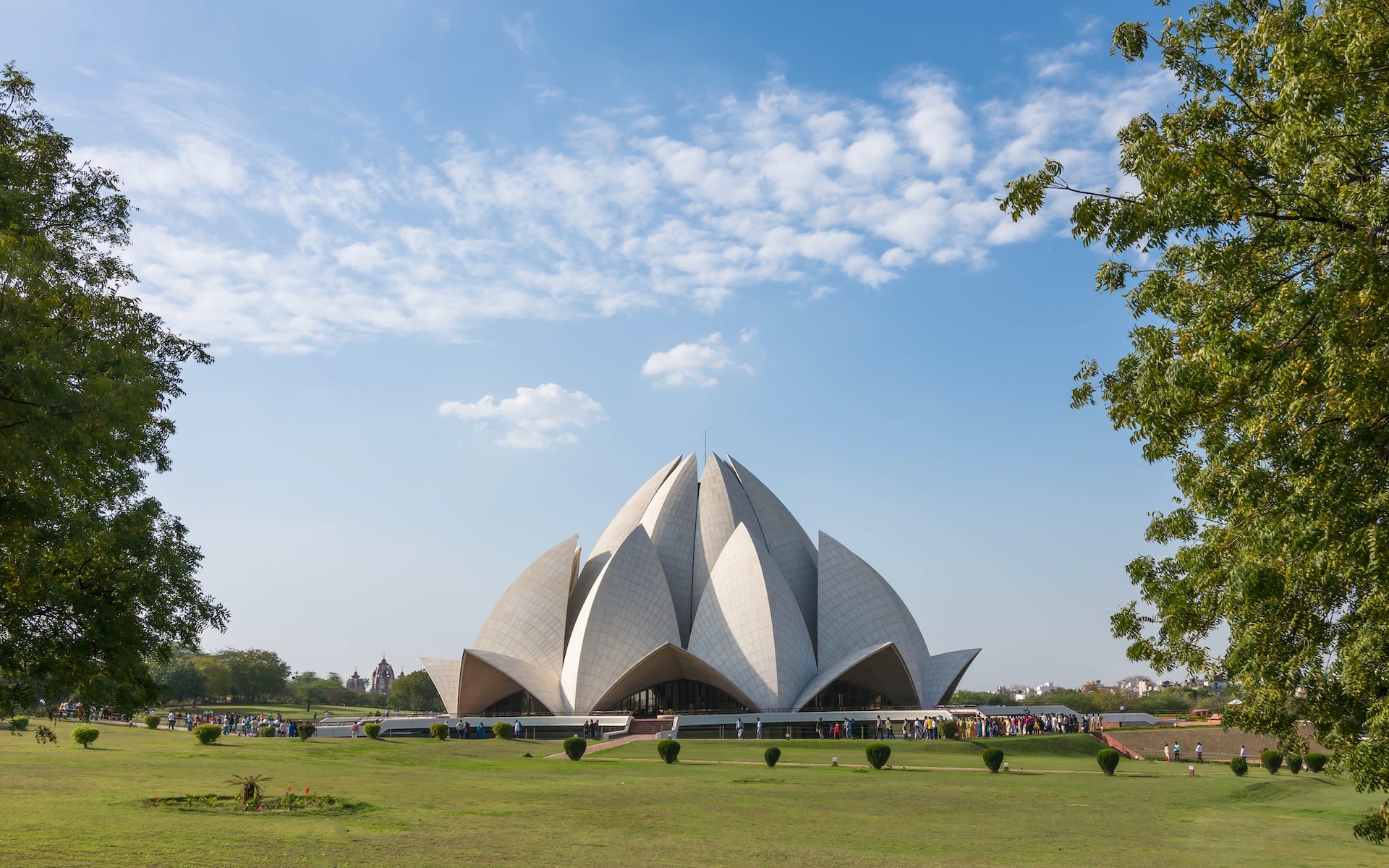
This nine-sided house of worship, with its striking central dome, is built from white marble and concrete in a shape that mimics a blooming lotus flower. Completed in 1986, it has drawn around seventy million visitors over the years.
Despite being called a temple, the Lotus Temple has no religious pictures, idols or symbols of any particular faith. It represents the Baha’i belief in the oneness of humanity rather than idolising any one ruler or religion. Entry is free; winter is the best season to visit for comfortable weather.
| Timings | 9:00 am to 5:00 pm |
| Entry Fee | Free |
| Nearest Metro Station | Kalkaji Mandir, New Delhi |
6. The Red Fort

Shah Jahan built the Red Fort, or Lal Qila, in 1648, and it served as the seat of the Mughal emperors until 1857. Its tall red sandstone walls enclose an area of around 2 sq. km. The main entrance, Lahore Gate, faces towards Lahore, leading into Chhatta Chowk, a bazaar selling silverware, gems, jewellery and silks.
Inside, the Naubat Khana once hosted court musicians, and its galleries still display instruments like gongs, kettledrums and cymbals. The white-marble Diwan-i-Am, the hall of public audiences, is also worth a visit. Plan a full-day tour to cover both New and Old Delhi.
| Timings | 9:30 am to 4:30 pm (closed on Mondays) |
| Entry Fee | ₹35 (Indians); ₹600 (foreign nationals), 2026 ASI rates |
| Nearest Metro Station | Chandni Chowk, New Delhi |
7. Lodi Gardens

Spread across 90 acres, Lodi Gardens holds relics from the Sayyid and Lodi dynasties (15th and 16th centuries), including several significant tombs, and is one of New Delhi’s most popular parks. It’s rich in flora and fauna too, with around a hundred native tree species, fifty butterfly species and a wide range of birds.
Architectural highlights date back to the 15th century, including mausoleums of Lodi sultans and a picturesque mosque. Look out for Athpula, a 16th-century eight-pier bridge with visually striking arches and columns. Afterward, take a short walk to Khan Market for shopping and street food.
| Timings | 6:00 am to 8:00 pm (approximate) |
| Entry Fee | Free |
| Nearest Metro Station | Jor Bagh, New Delhi |
8. Jama Masjid

Jama Masjid was Shah Jahan’s final major architectural achievement, completed in 1658. It has four angular towers, three entrances and two 40-metre minarets, built with alternating vertical stripes of white marble and red sandstone.
Visitors can climb the southern minaret for sweeping views of Old Delhi. Remove your shoes before entering, dress modestly, and note that non-Muslims aren’t permitted inside during prayer times. Afterward, explore Chandni Chowk’s spice market nearby for chutneys, pickles, saffron and more.
| Timings | 7:00 am – 12:00 pm, 1:30 pm – 6:30 pm |
| Entry Fee | Free (camera fee may apply) |
| Nearest Metro Station | Jama Masjid, New Delhi |
9. Akshardham

Opened in 2007, Akshardham looks centuries older than it is, covered in intricate carvings that draw huge numbers of visitors. The main monument stands 43 metres tall, carved from pink sandstone and marble with depictions of plants, animals, musicians and dancers, supported by 234 ornamental pillars and nine domes.
- A theatre showing a film on the temple’s construction
- A 15-minute boat ride portraying Indian culture and history
- An enormous Yagnapurush Kund stepped water tank
- A musical fountain that lights up at night
| Timings | 10:00 am to 6:30 pm (closed on Mondays) |
| Entry Fee | Free (exhibitions, boat ride and fountain show charged separately) |
| Nearest Metro Station | Akshardham, New Delhi |
10. Purana Qila (The Old Fort)

Often overlooked in favour of the Red Fort, Purana Qila deserves a spot on your itinerary. Its history stretches back around 2,500 years, though much of the current structure dates to the 1500s. Covering roughly 2 sq. km, it played a notable role in the region’s affairs and reflects strong Islamic architectural influence.
Its parapets and gates make for a striking sight, especially when lit up at night. The nearby Mehrauli Archaeological Park is also worth exploring, with structures that date back around a thousand years.
| Timings | 7:00 am to 5:00 pm, every day |
| Entry Fee | ₹35 (Indians); ₹600 (foreign nationals), 2026 ASI rates |
| Nearest Metro Station | Indraprastha, New Delhi |
11. Rajpath (Kartavya Path) & Rashtrapati Bhavan

Also called the King’s Way, Rajpath (officially renamed Kartavya Path in 2022) is New Delhi’s ceremonial boulevard, running from Rashtrapati Bhavan, the official presidential residence, past India Gate, Vijay Chowk and the National Stadium. Lined with grass, ponds and trees, it comes alive on Republic Day, 26 January.
Rashtrapati Bhavan blends European and Mughal architectural styles, making it a great photography spot. The Rashtrapati Bhavan Museum offers a look into past presidents’ lives, and if you visit in February or March, the Mughal Gardens are in full, spectacular bloom.
| Timings | 9:30 am to 5:30 pm |
| Circuit 1 | Open Thursday-Sunday |
| Circuit 2 | Open all days except Monday |
| Circuit 3 | Open Thursday-Sunday (November-March) |
| Entry Fee | ₹50 (approximate, booking required) |
| Nearest Metro Station | Central Secretariat, New Delhi |
12. Jantar Mantar

Built in 1725 by Maharaja Jai Singh near Connaught Place, Jantar Mantar is an astronomical observatory where visitors can observe instruments once used to track the sun, moon and planets, and to predict eclipses.
| Instrument | Function |
|---|---|
| Misra Yantra | Measures the longest and shortest days of the year, and noon time across cities worldwide |
| Samrat Yantra | Predicts the declination of celestial bodies |
| Rama Yantra | Measures a planet’s altitude |
| Jaiprakash Yantra | Calculates and verifies readings from the other instruments |
| Timings | 9:00 am to 7:00 pm, every day |
| Entry Fee | ₹5 (Indians); ₹100 (foreign nationals), approximate |
| Nearest Metro Station | Rajiv Chowk, New Delhi |
13. Laxminarayan Temple

Also known as Birla Mandir, this temple near Connaught Place was built in 1939 and dedicated to Lakshmi, the goddess of prosperity. At Mahatma Gandhi’s request, it also includes shrines for other faiths. Spread across almost eight acres, the grounds feature lush tropical gardens, sculptures and fountains.
Built of bricks and lime mortar, with cannon slots along the roof, the temple blends fort and temple architecture in a style that sets it apart from Delhi’s other landmarks.
| Timings | 4:30 am to 1:00 pm, 2:30 pm to 9:00 pm, every day |
| Entry Fee | Free |
| Nearest Metro Station | RK Ashram Marg, New Delhi |
14. Indira Gandhi Memorial

This was once the residence of India’s former Prime Minister, Indira Gandhi, and the site of her assassination in 1984. It is now a museum displaying artefacts and memorabilia from her life, including the sari she wore when she died, rare personal photographs, and items belonging to Rajiv Gandhi.
The collection also includes newspaper clippings of her funeral and gifts she received from people around the world, offering a close, personal look at one of India’s most significant political figures.
| Timings | 9:30 am to 4:45 pm (closed on Mondays) |
| Entry Fee | Free |
| Nearest Metro Station | INA, New Delhi |
15. Connaught Place

Named after the Duke of Connaught, CP is one of New Delhi’s largest commercial and financial hubs. Beyond shopping, it hosts well-known colonial-era buildings, contemporary art spaces and vintage theatres, bringing you close to the everyday pulse of the city rather than a historical backdrop alone.
With restaurants, food chains, bars and lounges that keep the area buzzing well into the night, Connaught Place is a solid stop if you want to experience Delhi’s nightlife alongside its sightseeing.
| Timings | Open all day (shops and restaurants vary) |
| Entry Fee | Free |
| Nearest Metro Station | Rajiv Chowk, New Delhi |
How Can You See All 15 Places in 4 Days?
Group the sights by area to save travel time. This sample plan covers all 15 places. Avoid starting on a Monday, because the Red Fort, Akshardham and Indira Gandhi Memorial are closed that day.
Day 1: Old Delhi
Start at the Red Fort, then continue to Jama Masjid and the Chandni Chowk bazaar. Both sit close to the Chandni Chowk and Jama Masjid metro stations.
Day 2: Central Delhi
Visit India Gate and Rajpath & Rashtrapati Bhavan in the morning. Spend the afternoon at Jantar Mantar, the Laxminarayan Temple and Connaught Place, which is the best place for dinner.
Day 3: South Delhi
Begin at Humayun’s Tomb and Lodi Gardens. After lunch, see Qutub Minar, Hauz Khas and the Lotus Temple, which is best at sunset.
Day 4: Museums and Monuments
Explore Purana Qila and the Indira Gandhi Memorial, then finish at Akshardham, which has the most to see of the three.
What Should You Know Before Visiting Delhi?
When is the best time to visit?
October to March, Delhi’s winter season, is the most comfortable time to explore the city on foot. Summers get very hot, so plan early morning or evening visits if you travel between April and June.
Air quality can dip in late autumn and early winter, so check the AQI before outdoor days. Our explainer on the causes of Delhi’s air pollution covers why this happens.
Practical tips for first-time visitors
- Book ASI monument tickets online in advance where possible to skip queues.
- Keep some cash handy, even though most monuments accept digital payments.
- Use the Delhi Metro, it’s the fastest and most reliable way to get between most of these sights.
- Dress modestly when visiting religious sites like Jama Masjid and Laxminarayan Temple.
Planning a longer India trip? See our guide to the top 10 summer vacation destinations in India for more ideas.
Related travel guides
- Top 5 historical Gurudwaras in New Delhi
- Exploring Haridwar: famous temples and adventurous activities
- Mathura’s famous temples and their heritage
Key Takeaways
- ✓India Gate, Humayun’s Tomb, Qutub Minar and Red Fort are Delhi’s most iconic landmarks, with 3 UNESCO World Heritage Sites among them.
- ✓October to March is the best season to visit, with 3-4 days enough to cover the main attractions.
- ✓ASI monument entry for Indians is ₹35 at most protected sites, ₹600 for foreign nationals, as of 2026.
- ✓Many landmarks, including Lotus Temple, Lodi Gardens and India Gate, are completely free to visit.
- ✓The Delhi Metro is the easiest way to reach most of these places, and several are within walking distance of each other.
FAQs: Places to Visit in Delhi
What is the best time to visit Delhi?
October to March is the most comfortable time to visit, with cooler weather that makes sightseeing easier. Summers, from April to June, get very hot.
How many days do I need to see Delhi?
Most travellers can cover the main attractions, including India Gate, Humayun’s Tomb, Qutub Minar and Red Fort, in about 3-4 days.
Which places in Delhi are UNESCO World Heritage Sites?
Humayun’s Tomb, Qutub Minar and the Red Fort are Delhi’s three UNESCO World Heritage Sites.
What is the entry fee for ASI monuments in Delhi?
As of 2026, ASI-protected monuments like Humayun’s Tomb, Qutub Minar, Red Fort and Purana Qila charge ₹35 for Indian nationals and ₹600 for foreign nationals.
Which places in Delhi are free to visit?
India Gate, Lotus Temple, Lodi Gardens, Laxminarayan Temple, Indira Gandhi Memorial and Connaught Place are all free to enter.
What is the easiest way to get around Delhi?
The Delhi Metro is generally the fastest and most reliable way to reach most major attractions, many of which are close to a metro station.