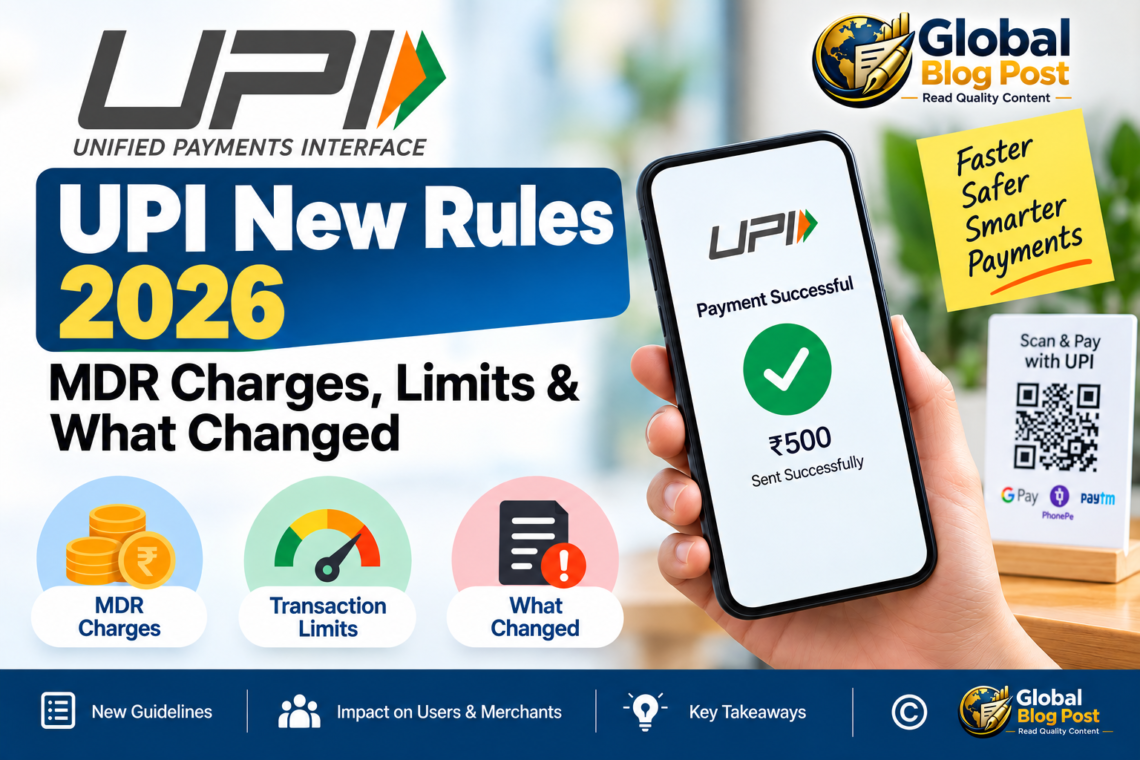
UPI remains free for all person-to-person (P2P) payments in 2026. A new 0.4% Merchant Discount Rate (capped at ₹300) applies only to specified merchant transactions above ₹2,000, effective October 15, 2026. Daily limits stay at ₹1 lakh for P2P and up to ₹10 lakh for select verified merchant categories. New features include UPI Circle (family delegated payments) and UPI Lite X (offline payments).
Introduction: Why 2026 Is a Turning Point for UPI
UPI has become part of everyday life in India — paying at a shop, sending money to a friend, settling a bill, or shopping online. Its scale is enormous: UPI processed 2,366 crore transactions worth ₹29.9 lakh crore in July 2026 alone, and the system is now live in 11 foreign countries.
At that volume, even a small structural change ripples across the entire financial ecosystem. UPI has been free for everyone since it launched, but 2026 has brought its biggest policy shift yet, with NPCI introducing merchant charges on certain UPI transactions, alongside raised transaction limits for hospitals and tax payments, a new UPI Circle feature for delegated family payments, and UPI Lite X for offline payments without internet.
Unified Payments Interface (UPI) is India’s real-time mobile payment system, operated by the National Payments Corporation of India (NPCI) under guidelines from the Reserve Bank of India (RBI).
This guide breaks down every confirmed change, separates fact from proposal, and answers the questions people are actually searching for.
Is UPI Still Free in 2026?
Yes — for consumers. UPI remains completely free for peer-to-peer (P2P) payments and for merchant payments under ₹2,000. The only new charge is a 0.4% Merchant Discount Rate (MDR) applied to select merchant transactions above ₹2,000, starting October 15, 2026 — and even this is paid by the merchant’s payment processor, not deducted from the customer.
The latest Government clarification confirms that P2P UPI payments remain completely free, and merchant payments up to ₹2,000 stay free of MDR as well. Any future MDR would be limited to specified merchant transactions above a threshold, charged at a nominal rate, and the final framework is still being decided.
Key definition: MDR (Merchant Discount Rate) is a fee charged to merchants for accepting digital payments — it is not a consumer-facing charge.
What Is the New UPI MDR Rule (October 15, 2026)?
A 0.4% MDR applies to specified person-to-merchant (P2M) UPI transactions above ₹2,000, capped at ₹300 per transaction, starting October 15, 2026.
- The 0.4% rate applies only to eligible merchant transactions exceeding ₹2,000.
- The fee is capped at a maximum of ₹300 per transaction for high-value payments exceeding ₹75,000.
- NPCI’s stated goal is supporting the long-term sustainability, infrastructure, and security of the digital payments ecosystem.
- P2P transactions and merchant payments under ₹2,000 are unaffected.
Key definition: P2M (Person-to-Merchant) refers to payments made by a customer to a business, as opposed to P2P (Person-to-Person) transfers between individuals.
A Separate, Already-Active Charge: PPI Interchange Fee
- NPCI has introduced a 1.1% interchange fee on UPI payments made via Prepaid Payment Instruments (PPIs) — such as Paytm Wallet, Amazon Pay, or PhonePe Wallet — when the transaction exceeds ₹2,000 at a merchant.
- If you pay a merchant directly from your bank account via UPI (how most people pay), there is no charge. This fee only applies to wallet-funded payments and is absorbed within the payment chain, not charged visibly to the customer.
What Are the UPI Transaction Limits in 2026?
The daily UPI limit is ₹1 lakh for P2P transfers and up to ₹10 lakh for select verified merchant categories.
| Transaction Type | Daily Limit |
|---|---|
| P2P (person-to-person) | ₹1 lakh |
| P2M — selected verified merchant categories | Up to ₹10 lakh |
| Hospital and tax payments | Raised category-specific limits |
| Bank/PSP-specific caps | May vary by risk profile |
- NPCI revised the P2M limit effective September 15, allowing merchant transactions up to ₹10 lakh per day for selected verified categories.
- The P2P limit remains unchanged at ₹1 lakh per day.
- Transaction limits have specifically been raised for hospitals and tax payments, reflecting UPI’s growing role in large, one-off payments.
- Actual limits can vary by user profile, transaction history, and each bank or payment service provider’s own risk evaluation.
What Is the New Payee Verification Feature?
NPCI has introduced a system that verifies and displays accurate account-holder information before a payment is executed, to prevent misdirected transfers.
- It applies to both P2P and P2PM transactions.
- The goal is to protect user funds and reduce confusion caused by selecting the wrong contact.
- Users are shown verified payee details before confirming a payment.
- This benefits users of major apps including Google Pay, PhonePe, Paytm, and BHIM.
What Security and Speed Upgrades Came With UPI Rules 2026?
Backend upgrades have cut transaction processing time to under 15 seconds and added stronger fraud-prevention checks.
- Many transactions now complete in near real time, within 15 seconds, with faster balance and status checks.
- These backend changes originated in NPCI operational guidelines introduced from August 2025, with effects becoming visible through 2026.
- Multi-factor authentication frameworks and tighter timing windows for auto-debit mandates are now part of the rule set.
- For routine users, day-to-day payment experience doesn’t change much — updates mostly work behind the scenes, strengthening security for risky transactions and shifting fraud accountability toward banks.
What New UPI Features Launched in 2026?
Two new products — UPI Circle and UPI Lite X — expanded who can use UPI and how.
- UPI Circle: Enables delegated payments for families, letting a primary account holder extend limited payment access to family members.
- UPI Lite X: Brings offline UPI payments that work without an internet connection.
- UPI 123Pay (unchanged): The IVR-based service for feature phones remains active — non-smartphone users can dial in to pay without internet, unchanged in 2026.
Which UPI Changes Are Still Just Proposals (Not Law)?
A proposed ₹10,000 transfer delay and an app “kill switch” are NOT confirmed rules — they remain under discussion.
- Any headline claiming these are “already in effect” should be treated with caution until RBI or NPCI issues formal confirmation.
- A separate proposal aimed at preventing any single third-party UPI app from dominating the ecosystem has a compliance deadline extended to December 31, 2026.
- These larger proposed shifts would matter more for users if implemented — but they are not law yet.
Conclusion: What Actually Changes for You
- Everyday consumers: Almost nothing changes — P2P transfers stay free.
- Merchants accepting payments above ₹2,000: A new 0.4% MDR (capped at ₹300) begins October 15, 2026.
- Wallet users making merchant payments above ₹2,000: A 1.1% interchange fee already applies, typically absorbed in the payment chain.
- Businesses: Need to track new compliance requirements around authentication and fraud accountability.
- Everyone: Benefits from faster processing, payee verification, and new offline/family payment options.
Always rely on official information from the Government, RBI, and NPCI for updates, especially regarding proposals still under discussion.
Frequently Asked Questions
Will I be charged for sending money to a friend?
No. Person-to-person (P2P) UPI transactions remain completely free in 2026.
Is every UPI payment above ₹2,000 now charged?
No. The ₹2,000 threshold applies only to specified merchant (P2M) transactions under the new MDR framework — not to a blanket consumer fee.
What is the daily UPI transaction limit in 2026?
₹1 lakh per day for standard P2P transfers, and up to ₹10 lakh per day for select verified merchant categories.
When does the new UPI MDR framework take effect?
October 15, 2026.
Are UPI transfer delays and app “kill switches” real rules now?
No — these remain proposals, not confirmed regulations.
Do I need to do anything differently as a regular user?
No. Everyday P2P payments and small merchant payments continue exactly as before.